Alvernia University
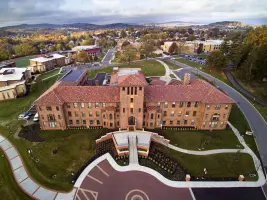
Alvernia University’s nursing programs are based on its Reading campus. Coursework and skills training centered in the John and Karen Arnold School of Nursing. Reading sits in Berks County, with commuter access from the greater Lancaster, Lehigh Valley, and Philadelphia regions via major routes like US-422 and I-176; students typically plan around local traffic patterns when traveling to campus and clinical assignments.
The School of Nursing includes a dedicated Healthcare Simulation Center that opened in fall 2023 as part of a 55,000-square-foot expansion. Students practice in simulation spaces designed for fundamentals skills, health assessment, standardized patient scenarios, and a resuscitation quality intervention (RQI) area, then apply those skills in clinical settings. At the graduate level, Alvernia notes clinical and practicum placements supported through partners such as Tower Health and Penn State Health, with faculty assisting students in arranging precepted experiences near their location.
Program options cover multiple entry points and career stages: a pre-licensure BSN, an online RN to BSN completion program (with up to 90 transfer credits and a fast path as short as 12 months), and graduate study through an online MSN with Education and Leadership tracks, plus a Family Nurse Practitioner option. The BSN curriculum is built to integrate nursing theory with clinical practice across the lifespan; admissions and progression policies include requirements such as the ATI TEAS and defined minimum grades in nursing and science coursework. Graduate MSN coursework is designed around role development in nursing education or leadership, paired with precepted experiences.
Alvernia is a Catholic, Franciscan-affiliated university and welcomes students of all faith backgrounds; the nursing curriculum highlights ethics and service as part of that tradition.
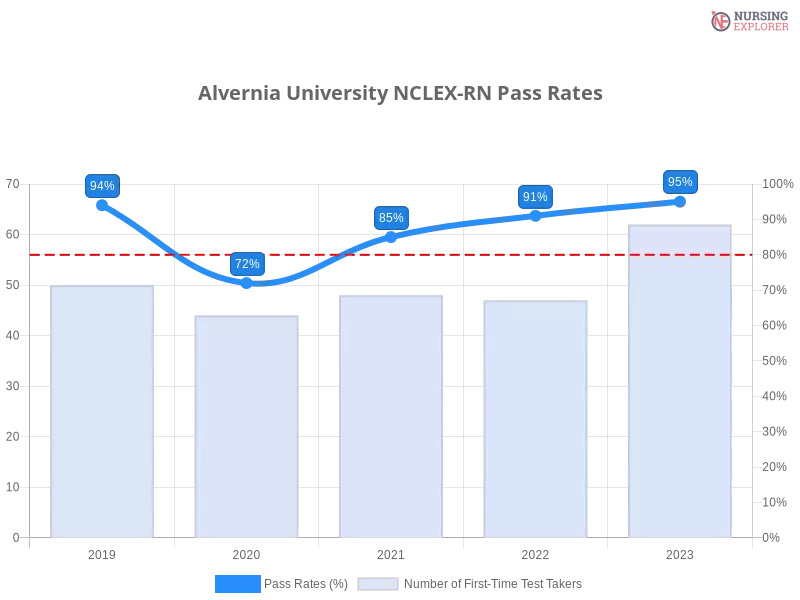
On NCLEX performance, the program’s average weighted NCLEX-RN pass rate is 96.8%, which compares favorably with Pennsylvania’s 2024 state average of 94.1%.
NCLEX-RN Pass Rates
Accreditations
Nursing Programs Accreditations
- Nursing (CNURED) - Nursing education programs at the baccalaureate degree levels Accredited by Commission on Collegiate Nursing Education
- Nursing (CNURED) - Nursing education programs at the graduate degree levels Accredited by Commission on Collegiate Nursing Education
Institutional Accreditations
- Middle States Commission on Higher Education
Nearby Nursing Schools