Pima Community College
The ADN program at Pima Community College provides students with the knowledge and clinical experience needed to pass the NCLEX-RN exam and start a career as a Registered Nurse. The program typically spans 5-6 semesters and is highly competitive.
Admission Requirements
- Prerequisites: Students must complete several prerequisite courses with strong grades before applying:
- BIO 201IN or BIO 201IH: Human Anatomy and Physiology I with a grade of "B" or better.
- BIO 202IN: Human Anatomy and Physiology II with a grade of "B" or better.
- MAT 142 or higher: College Mathematics with a grade of "C" or better.
- WRT 101: College Composition with a grade of "C" or better.
- Competitive Admission: Admission is based on academic performance in these prerequisites, and only the most qualified applicants are admitted.
Program Structure
The ADN program follows a cohort model, meaning students progress through the curriculum together as a group. Key components include:
- Core Nursing Courses: Students will engage in both theoretical and practical training. The curriculum includes courses on nursing processes, pharmacology, and specialized labs for clinical skills development.
- Clinical Rotations: Students participate in clinical rotations in various healthcare settings, gaining hands-on experience in patient care under the supervision of experienced nurses.
Concurrent Enrollment Program (CEP)
For those interested in advancing their education further, PCC offers a Concurrent Enrollment Program (CEP) in partnership with universities. This program allows students to work towards a Bachelor of Science in Nursing (BSN) while completing their ADN, providing a streamlined pathway to higher education
Pima Community College’s Center for Training and Development offers a licensed practical nursing program that is approved by the Arizona State Board of Nursing. The program is ideal for students who have obligations outside of school, such as work or children because they offer either weekday classes or classes on evenings and weekends.
After completing this course the student will be given a certificate (non-credit certificate) and will be eligible to take the licensing exam. The course prepares the student to work in a variety of health care settings with classes such as Health Care Fundamentals and Introduction to Practical nursing.
Admission into the program is offered five times each year. To qualify for admission potential students must take the Accuplacer exam and pass with satisfactory scores. Candidates for the program must also obtain a fingerprint clearance card as well as pass a drug test and show documentation of current immunizations and TB skin test.
The program accepts transfer students from other accredited schools that have completed all of the necessary prerequisites. Also with completion of this course and with successful completion of the licensing process, the student has an option to get admitted into the associate degree-nursing program offered by PCC’s Center for Training and development.
PCC offers an ADN-PN step-out option for students who complete the first three semesters of the ADN program. This allows them to sit for the NCLEX-PN exam and obtain their Licensed Practical Nurse (LPN) license. This flexibility is beneficial for students who may want to begin working sooner while continuing their education towards an RN
NCLEX-RN Pass Rates

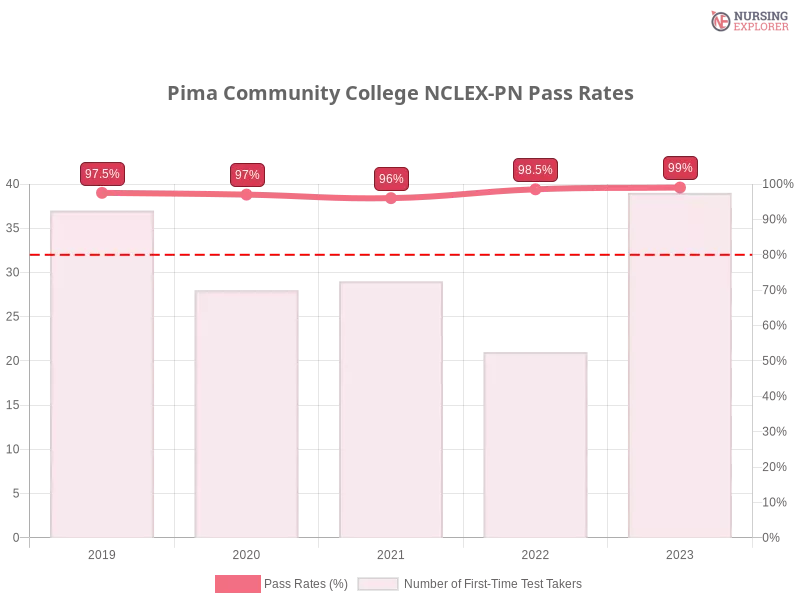
NCLEX-PN Pass Rates
Accreditations
Nursing Programs Accreditations
- Nursing (ADNUR) - Associate degree programs Accredited by Accreditation Commission for Education in Nursing, Inc. (Formerly: National League for Nursing Accrediting Commission)
Institutional Accreditations
- North Central Association of Colleges and Schools, The Higher Learning Commission
Nearby Nursing Schools