
Arkansas Tech University
Arkansas Tech University’s nursing programs are based on the main campus in Russellville, with the Department of Nursing housed in Dean Hall (Dean Hall, Room 126). Russellville sits along I?40 in the Arkansas River Valley, roughly midway between Little Rock and Fort Smith, which matters for clinical travel and commuting; many students drive in from nearby Pope and Yell County communities, while others commute from the western edge of the Little Rock metro depending on schedule and traffic.
ATU is a public university setting with four nursing pathways: a traditional prelicensure BSN, an LPN-to-BSN option offered either face-to-face or in a hybrid format, an online RN-to-BSN completion program, and an MSN in Nursing Administration and Emergency Management (noted as completable online). Progression policies are structured and closely tied to course sequencing: in upper-division nursing coursework, students must earn a “C” or better in nursing courses (electives excluded), and the program limits course repeats (generally one repeat; a second failure can lead to dismissal, with defined appeal and readmission processes).
Admission to the prelicensure BSN upper division is competitive, with set application deadlines (February 15 for fall entry and September 15 for spring entry). Minimum eligibility includes a 2.75 prerequisite GPA, completion of specific prerequisites (such as A&P, microbiology, chemistry with lab, psychology, sociology, and nutrition) with grades of C or better, and an entrance exam score at the proficient level or higher. Clinical eligibility requirements listed by the department include a criminal background check, American Heart Association BLS-CPR, required immunizations (including Hepatitis B series/titer), and student liability insurance through ATU.
For licensed nurses, ATU follows the Arkansas Nursing Education Progression Model and awards articulated credit (17 hours for LPN/LPTN progression; 38 hours for RN progression) once ATU coursework is completed. The MSN requires 33 credit hours and offers concentration work in either Nursing Administration (including a practicum) or Emergency Management.
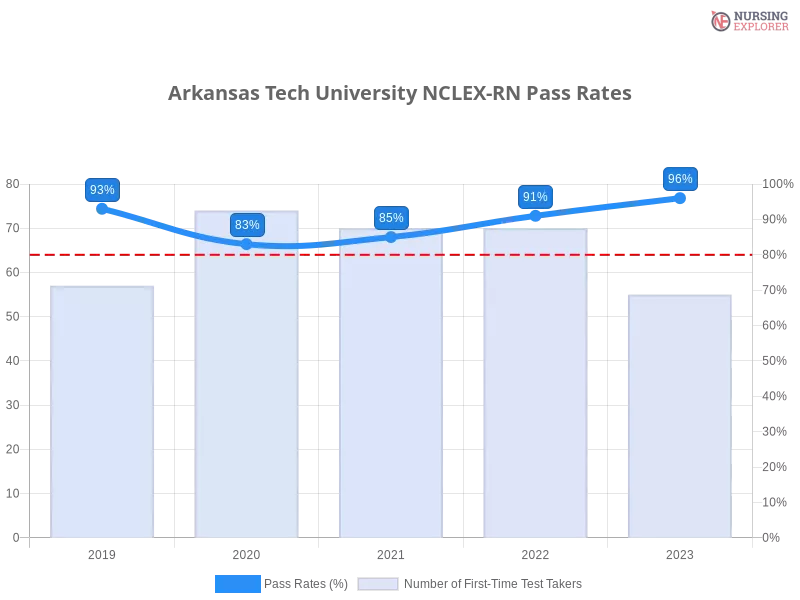
Based on Arkansas Board of Nursing data, ATU’s average weighted NCLEX-RN pass rate is 91.3%, compared with the 2024 Arkansas state RN average of 91.1%.
The Arkansas Tech University nursing program is approved by the Arkansas State Board of Nursing and the Arkansas Department of Higher Education.
The program leads to the BSN degree after completing eight semesters of general education, course pre-requisites, and upper-division professional nursing courses.
The program employs clinical facilities and services in the Arkansas River Valley area although students should be prepared to travel out of this area to meet the objectives of certain courses.
Admissions requirements for the Nursing program:
- Prerequisite grade point average of 3.0 on a 4.0 scale.
- Complete General Education Requirements
- CPR certification, student liability insurance, criminal background check and initiation of Hepatitis B shots
All application documents need to be submitted to the Department of nursing by the 1st of March for admission in the following fall semester. Applicants will be selected according to established admission criteria and ranked according to GPA.
Successful applicants will be required to complete the program within four years of entry into level one of the nursing curriculum. Students will need to maintain CPR certification, liability insurance and annual criminal background check throughout period of enrollment.
ATU also offers an RN to BSN completion program online as well as the regular on-campus program.
The Arkansas Tech University Master of Science in Nursing utilizes a multi-disciplinary approach which integrates a range of nursing administration principles for students engaged in specializations related to emergency management administration in a range of health care settings.
The core curriculum for the MSN program includes 27 semester hours of coursework in research design and methods, epidemiology, legal and ethical issues, nurse administration, health care trends, theoretical perspectives, principles of hazards and design and management of preparedness in mitigation systems, emergency management, and research project.
Students in the nursing administration and in the emergency management specialty options will complete an additional 12 semester credit hours.
Admission Requirements:
- Meet admission requirements for Graduate College
- Bachelor of Science Degree in nursing from a CCNE or NLNAC accredited program
- Cumulative Grade Point Average of 3.0
- Current, valid and unencumbered License to practice as a Registered Nurse
- GRE or MAT Test scores
- Successfully complete a basic statistics course
- Approval from the program admission committee
Applicants who don’t meet all the above requirements may be accepted into the program on a conditional basis by the admissions committee to earn a maximum of 12 graduate credits hours with a CGPA of 3.0 at which point the condition will be removed.
NCLEX-RN Pass Rates
Accreditations
Nursing Programs Accreditations
- Nursing (MNUR) - Master's program Accredited by Accreditation Commission for Education in Nursing, Inc. (Formerly: National League for Nursing Accrediting Commission)
- Nursing (NUR) - Baccalaureate program Accredited by Accreditation Commission for Education in Nursing, Inc. (Formerly: National League for Nursing Accrediting Commission)
Institutional Accreditations
- North Central Association of Colleges and Schools, The Higher Learning Commission
Nearby Nursing Schools